
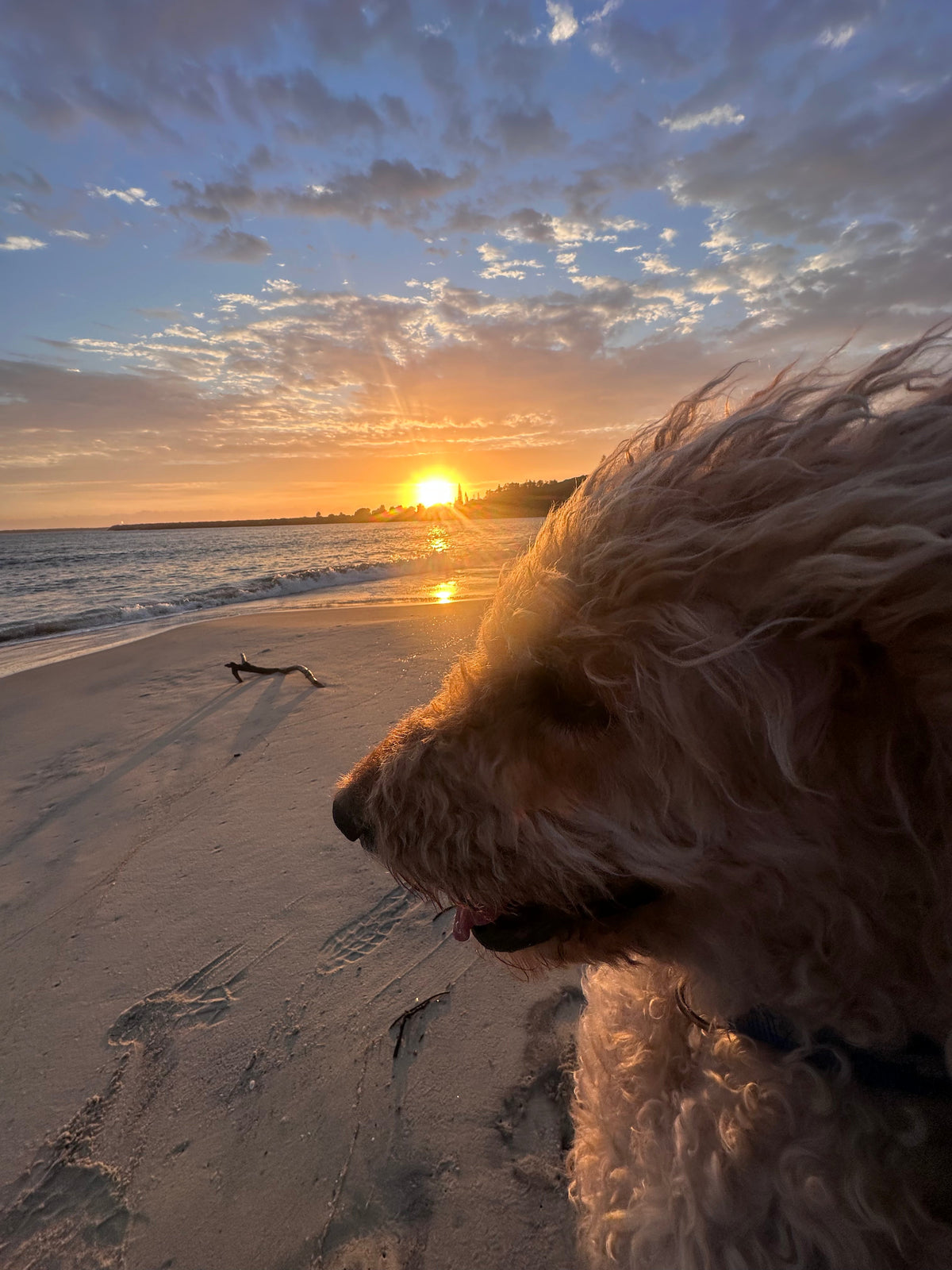
By Grant Shannon, founder of Dogs Connect and designer of The Enricher
The short version: my dog Sonny used to spend my absences fixated on one question — where had I gone, and when was I coming back? Every return, even after half an hour, turned into a full reunion. What changed it wasn't more of me. It was giving him good things to anticipate that had nothing to do with me. That idea became The Enricher.
I was his source of everything
Until this point, Sonny worked in many different settings such as schools, hospitals, and prisons. He was very accustomed and comfortable with lots of interaction and stimulation.
When Sonny retired, he started spending most of his days with me in the office, or out exploring and sniffing on our walks. It was a good life. But I'd accidentally made myself the centre of all of it.
I was where the food came from. The play, the outings, the interesting things. Without meaning to, I had become his stimulation enabler — and so his attention went where the good things came from. Me.
That's fine when you're together. When I left, it meant his day revolved around my absence. He waited. And when I got home, it was nearly impossible to get past him at the door without a genuine reunion, every single time. Even if I'd only been gone for thirty minutes.
Why this happens to so many dogs
Dogs are associative learners. They connect experiences with whatever reliably comes with them.
Think of the person at the dog park with treats in their pocket. Every dog there knows exactly who he is, and lights up when he arrives. That's a positive association: the person is the good thing.
Most of us build exactly that association with our own dogs, completely accidentally. We're the walk, the dinner, the game and the company. In my work through Dogs Connect I see it constantly, in loving homes. And when we're the only source of good things, our leaving becomes the low point of the day, and our return becomes the event.
It isn't a training failure. It's simply how dogs learn. Which means it can be learned differently.
What I changed
I wanted good things to happen for Sonny at home when I wasn't there — things he could find, solve and enjoy on his own. And I wanted them spread through the day, not all handed over as I walked out the door.
A few things mattered more than I expected:
- The surprise. I hung the setup up high rather than putting it on the ground. Sonny couldn't help himself to it; things simply arrived. That element of surprise turned out to be half the fun for him.
- Variety. Not just food. Chews, a ball, a squeaky toy, puzzle toys — things he had to sniff, nudge, paw at and think about.
- The timing of the last one. I set one release to land just before I get home. By the time I walk in, he's busy with something good. There's no frantic rush to the door. That single change transformed our arrivals.
What changed for Sonny
The change I love most is that he started thinking for himself more. If the Enricher isn't loaded, he goes looking for something else to do — an old bone, a toy he hasn't touched in weeks. He's learned that he can find stimulation and satisfaction on his own.
He also has a completely new association with being home alone. Being at home without me now means things to look forward to, not just waiting.
And my homecomings are calm. He's pleased to see me — of course he is — but my return is no longer the only good thing in his day. He even signals towards the Enricher when I head outside.
Imagine knowing your dog is content, stimulated and satisfied while you're out — and that none of it depends on you being there. That's what I wanted for Sonny, and it's what I want for every dog.
From Sonny to The Enricher
What worked for Sonny became The Enricher: a wall- or post-mounted device with four compartments, each released on a timer you set with a simple dial. You load it in the morning, choose your intervals, and your dog gets four new moments spread through the day. No app, no Wi-Fi, no subscription. Designed and made in Australia.
If your dog's day revolves around your absence, start with the routine. What Is Scheduled Enrichment? walks through how to build one, with a sample day.
Treat them like family. Let them be dogs.
Frequently asked questions
Why does my dog wait at the door all day? Often because you're the main source of good things in their life, so your return is the biggest event of the day. Giving your dog enjoyable things to do while you're out can shift that focus.
Why is my dog so over-excited when I come home? Usually the same reason. Calm, low-key arrivals help, and so does making sure something good has happened during the day, not just when you walk in.
How do I help my dog be more independent? Build positive experiences that aren't tied to you: enrichment they can do alone, spread through the day, plus calm, predictable departures and arrivals.
Is a dog waiting at the door a sign of separation anxiety? Not necessarily. Many dogs simply anticipate their owner's return. If your dog shows significant distress when alone — constant vocalising, destroying exits, self-injury — talk to your vet or a qualified behaviour professional. The Enricher is an enrichment tool, not a treatment for clinical conditions.
Grant Shannon is the founder of Dogs Connect and the designer of The Enricher. He is IAABC ACD certified and has spent more than 15 years working in dog behaviour, wellbeing and education, including placing wellbeing dogs in more than 400 schools and community settings across Australia.
Share:
What Is Scheduled Enrichment? Why the Timing of Your Dog's Enrichment Matters